
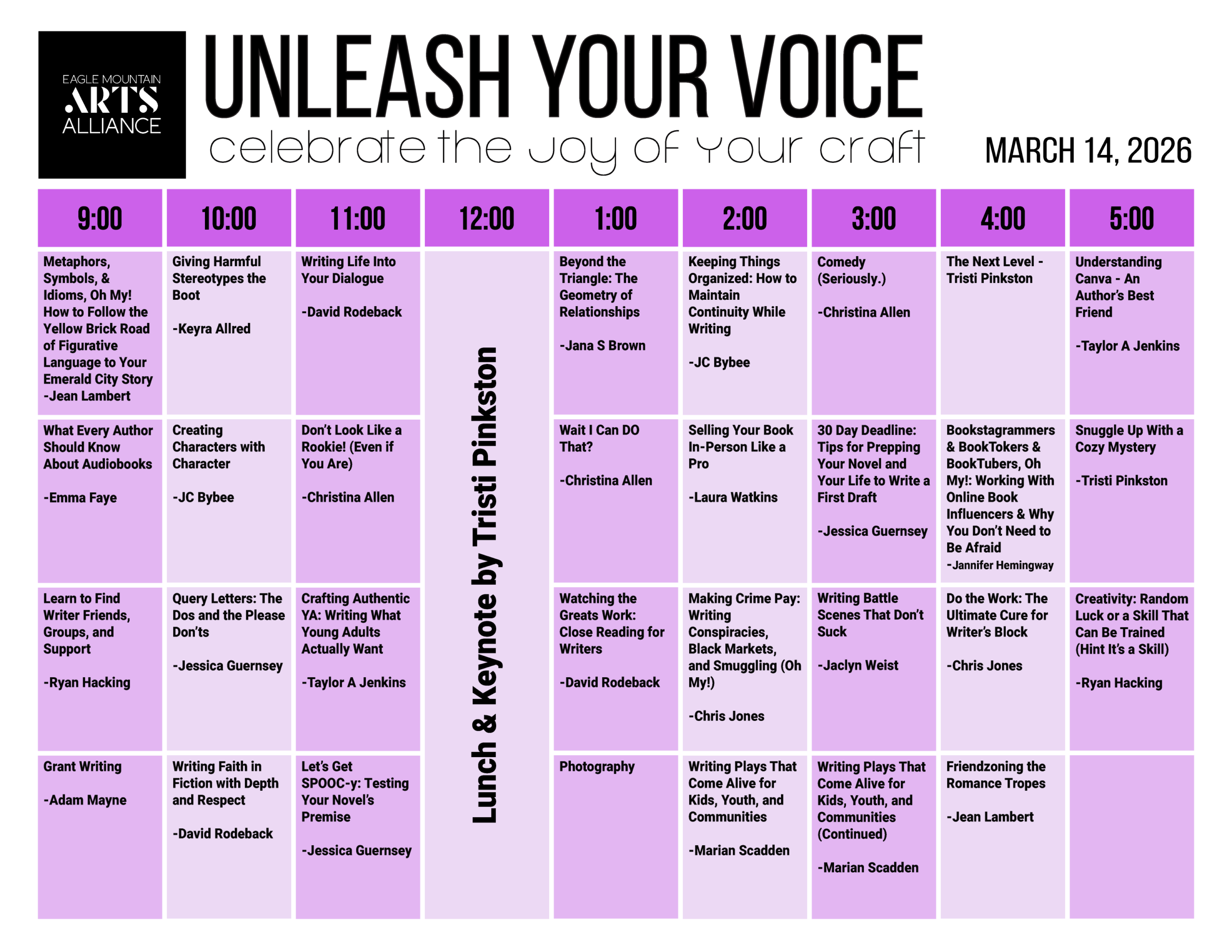
class details
breakout session 1 – 9:00
Metaphors, Symbols, & Idioms, Oh My! How to Follow the Yellow Brick Road of Figurative Language to Your Emerald City Story – Jean Lambert
How to Follow the Yellow Brick Road of Figurative Language to Your Emerald City Story
What Every Author Should Know About Audiobooks – Emma Faye
Audiobooks are becoming increasingly mainstream, and more readers will be requesting them. In this session, professional narrator Emma Faye guides authors through the entire audiobook production process. From platforms to casting and working with narrators, to managing timelines and budgets. You’ll walk away with actionable knowledge to confidently produce your audiobook like a pro. Whether you’re just curious or ready to dive in, you’ll leave with a clear understanding of the audiobook process. Don’t miss this opportunity to continue the oral tradition in the modern age!
Learn to Find Writer Friends, Groups, and Support – Ryan Hacking
I looked for years for fellow writers to inspire, help support, and to just be friends. None appeared in my basement office. I had to leave the house. Actually interact with other authors. Where are they? How do I meet them? One of the first methods is conference attendance. You have taken that crucial first step come learn more steps to the dance of Introverted Networking.
Grant Writing – Adam Mayne
Coming Soon
Breakout Session 2 – 10:00
Giving Harmful Stereotypes the Boot – Keyra Allred
Exploring various themes, tropes, and stereotypes common in fiction, particularly romance, from Bury Your Gays to Power Dynamics to Tokenization, we will find ways to avoid alienating your characters and reader. We will discuss sensitivity readers for Queer/BIPOC circles, as well as Consent in Dark Romance and Fantasy, and Trauma Trivialization in order to best flesh out character and story. Find the story you always wanted to read.
Creating Characters with Character – JC Bybee
How to write characters people want to read
Query Letters: The Dos and the Please Don’ts – Jessica Guernsey
You finished your book! Now it’s time to look for an agent or publisher to get your masterpiece into the hands of readers. But how do you do that? The first step is frequently the hardest: writing the query letter. How do you make your query stand out from the dozen agents receive every day? How do you avoid a form rejection? And what should you do if all you’re getting is rejections? Take the advice of a slush pile reader who sees a hundred queries every quarter. Learn to hook the agent and make a good impression while avoiding the pitfalls of query letters.
Writing Faith in Fiction with Depth and Respect – David Rodeback
Techniques for writing characters with religious faith. Writing for various audiences about the author’s and others’ faiths; characters encountering their own and others’ faiths; the potential for layered conflict and stakes; seeing beyond dogma to how believers live their lives; and how to write respectfully (of faith and readers) and avoid stereotypes and other pitfalls. Major and minor roles faith might play in our stories, and how and why to ensure we’re telling stories, not preaching sermons, even when faith may be one of our motives for writing fiction at all.
Breakout Session 3 – 11:00
Writing Life Into Your Dialogue – David Rodeback
Natural-sounding dialogue comes easily when we converse, but not when we write. In this workshop we’ll discuss tools from the author’s toolbox and practice using them to turn clunky first-draft dialogue into moments that make characters and stories memorable. We’ll do things with punctuation your English teachers may not approve; consider disappearing dialogue tags, when to use the other kind, and what to do in between; explore sentence fragments, internal and external voices, techniques for helping your dialogue sound on the page as it sounds in your mind, and more.
Don’t Look Like a Rookie! (Even if You Are) – Christina Allen
Every writer has to start somewhere, but that doesn’t mean you want to be pegged as a rookie. Learn to avoid the most common beginner’s mistakes in line editing, formatting, submissions, and curating your personal brand so you can present yourself like a professional in person and online.
Crafting Authentic YA: Writing What Young Adults Actually Want – Taylor A Jenkins
YA is a very popular genre, but it can be tricky, especially when it comes to writing teenage characters. The question is: How do you create complex YA characters that your young audience will relate to, and more importantly, believe? Well, worry no longer! With the help of this class, I’ll show you how to create realistic, relatable, and most importantly, believable YA characters where readers feel true connections.
Let’s Get SPOOC-y: Testing Your Novel’s Premise – Jessica Guernsey
Ever get a good chunk of the way into a novel only to realize that your plot is weak? Your antagonist is cardboard? Or that your climax lacks punch? Use Deborah Chester’s SPOOC to test your premise before you get too far into the word count. Save yourself the heartache and struggle of a weak premise by combining the Setting, Protagonist, Obstacles, Opponent, and Climax into a two-sentence power punch to make your story strong before you start. And, if you do this well enough, it can serve as your elevator pitch and query letter booster.
Breakout Session 4 – 1:00
Beyond the Triangle: The Geometry of Relationships – Jana S Brown
No matter the genre you’re writing in, the relationships between characters is at the heart of making character believable and relatable. Come and join Jana S. Brown to talk about how relationships are used in writing to deepen character arcs, inform plots, and make your writing connect!
Wait I Can DO That – Christina Allen
A beginner’s introduction to publishing contracts, copyright, public domain, fair use, and other legal concerns for writers. From fan fiction to brand names and everything in between, come learn what’s allowed, how to stay out of trouble, and how to protect your rights as a creator.
Watching the Greats Work: Close Reading for Writers – David Rodeback
We’ll practice reading brilliant texts (for the sake of time, short ones) twice: first as a reader, for effect, and then as a writer, considering how each produces its effects and highlighting the layering of conflicts, tensions, emotions, actions, and themes. Along the way we’ll collect and rehearse set of techniques for writing and rewriting our way to richer, more engaging stories.
Photography
Coming Soon
Breakout Session 5 – 2:00
Keeping Things Organized: How to Maintain Continuity While Writing – JC Bybee
Coming Soon
Selling Your Book In-Person Like a Pro – Laura Watkins
Step up your in-person vendor and sales game. Basics and troubleshooting from a professional with more than 20 years of customer service, marketing, product production, and sales experience. We’ll cover basic booth setups, event and customer service dos and don’ts, basic merchandising, and how to sell without feeling like a used car salesman. Also: Collected best practices and tips from vendor veterans of Comic Con, FanX, Dragonsteel, Storymakers, and more.
Making Crime Pay: Writing Conspiracies, Black Markets, and Smuggling (Oh My!) – Chris Jones
Coming Soon
Writing Plays That Come Alive for Kids, Youth, and Communities – Marian Scadden
A lively, hands-on, crash course in playwriting with someone who directs and writes. Learn to adapt stories, invent new ones, format scripts correctly, estimate running time, and what to put in or leave out of parentheticals (where you give the actors instructions). We’ll delve into dialogue, along with dos, don’ts, and maybes. And you’ll write.
Breakout Session 6 – 3:00
Comedy (Seriously.) – Christina Allen
No matter your audience, genre, or format, applying the principles that make comedy writing work can take any project from predictable to un-put-downable! This presentation is geared toward writers of any level of experience, with writing from laugh out loud to deathly dramatic.
30 Day Deadline: Tips for Prepping Your Novel and Your Life for Writing a First Draft – Jessica Guernsey
Have a great story idea but just don’t have the time to get the words down? You can write the first draft of your novel in just one month. Success just needs a better plan, deeper prep, and smarter methods. Come learn the tips, tricks, and strategies to finish that draft faster than you thought possible. Use these techniques to meet your writing deadlines and goals no matter what your deadline.
Writing Battle Scenes That Don’t Suck – Jaclyn Weist
Want fight scenes that grip readers without confusing them or drowning in metaphors? This class teaches clear, fast, hard-hitting action: keep readers oriented, make every strike count, dial in the right gore level, reveal character through choices, and dodge the most common mistakes. Bring a scene—or just an idea—and leave with one that actually works. Fantasy, sci-fi, thriller—any genre with killing.
Writing Plays That Come Alive for Kids, Youth, and Communities – Marian Scadden
*Continued from the 2:00 class*
Breakout Session 7 – 4:00
The Next Level – Tristi Pinkston
You may have gotten all the grammar right, but there are other elements that can make your story fall flat. Learn to indentify unintentional puns, repetition, unnecessary details, and why removing them will make your story so much stronger.
Bookstagrammers & BookTokers & BookTubers, Oh My!: Working With Online Book Influencers and Why You Don’t Need to Be Afraid – Jannifer Hemingway
In this class, you’ll learn how to strengthen your author brand on social media, what to look for in book influencers, and how to approach influencers that can lead to powerful partnerships and boost your readership. You’ll be given steps on how to set up your own online book tour, even with a small amount of followers. By the end, you’ll know how to tap into the bookish community on social media and turn influencers into advocates for your work.
Do the Work: The Ultimate Cure for Writer’s Block – Chris Jones
Coming Soon
Friendzoning the Romance Tropes – Jean Lambert
Enemies to Lovers not exactly appropriate for your story? What about Enemies to Friends? Now that’s a friendship worth fighting for. Come see how to use popular and beloved Romance Tropes to add dynamic and more meaningful friendships into Middle Grade and other non-romance genres.
Breakout Session 8 – 5:00
Understanding Canva: An Author’s Best Friend – Taylor A Jenkins
Self-publishing can be time and money consuming. People always say marketing is an essential part of releasing a book, so how do you market your book, create professional content, and still have money left over? Worry no longer! Canva is a fun, easy way to create social media posts, reels, flyers, and even book covers. For those seeking to upscale their marketing strategy, this class is for you!
Snuggle Up With a Cozy Mystery – Tristi Pinkston
Cozy mysteries are a booming part of the industry, with more and more readers looking for great stories without the shock value. Award-winning cozy author Tristi Pinkston will walk you through the hallmarks of the genre and discuss ways you can get in on this exploding trend.
Creativity – Random luck or A skill that can be trained. Hint: It’s a Skill – Ryan Hacking
Come learn techniques, methods, and skills for increasing creativity. Then practice them with real writers who volunteer while you do the same steps on your paper to create your own next story. All new skills need practice to become better. Begin training your creativity today.